
How to Navigate Peak Times: A Photographer's Guide to Busy Days
February 27, 2026

Search Engine Optimisation (SEO) might initially appear secondary for photographers, who often rely heavily on visual appeal and word-of-mouth to grow their business. However, in a digital world where countless photographers are competing for attention, SEO has become an indispensable tool for standing out. The online visibility of a photography business can significantly impact its ability to attract new clients and establish a strong brand presence.
In today's competitive photography market, potential clients frequently start their search for photography services online. Without a strong SEO strategy, your work might never reach its intended audience, no matter how impressive. This makes SEO not just a technical necessity, but a critical marketing strategy to ensure that when someone searches for photography services, your business appears prominently in search engine results.
Additionally, SEO helps photographers to be found precisely by those searching for their niche—whether that be wedding photography, portrait photography, or event coverage in a particular location. By using targeted keywords, and optimising your content, you can effectively guide potential clients right to your doorstep.
As competition intensifies, the need to differentiate yourself from the competition becomes even more crucial. SEO provides the tools not only to compete but also to stand out by keeping your business visible, accessible, and appealing to potential clients as they navigate through countless options online.
Before we dive into lesser-known techniques that can give you an edge, let's ensure we're clear on the basics. SEO in essence involves optimising your website so it ranks higher in search engine results for keywords related to your services.
It’s well-known that content is crucial for SEO, but for photographers, the context of this content can be a game-changer. Search engines are increasingly adept at understanding the context surrounding content. This means that simply posting beautiful images isn’t enough. You need to accompany these images with rich, relevant text. For instance, describing the techniques behind a shot or the story of a photography session can keep users spending more time reading your website and signal to search engines that your site is a credible source of information on the subject.
Topical authority refers to your website’s reputation as a go-to resource for a particular subject. For photographers, building topical authority is all about demonstrating deep knowledge in your areas of specialisation through comprehensive and insightful content, including client testimonials, blog posts about photography tips, and case studies of your shoots.
Once you have a plan of attack to tackle your authoritative content, it's time to ensure it reaches the right audience. Here are some must-have strategies to help you achieve this:
Identify keywords that potential clients might use to find services like yours. Tools such as Google Keyword Planner can help you discover relevant keywords, such as "best wedding photographer near me."
But to even start your search, you first need to determine which keywords are most relevant to your photography business. These keywords should reflect the services you offer, your style, and where you are based. Here are some keywords photographers can use for effective SEO:
Once you’ve identified your target keywords, the next step is to incorporate them into your website. Here’s how to do it effectively:
Example in Action
Imagine you’re a wedding photographer in London. Your primary keyword might be "London wedding photographer," but you could also target "engagement photography in London," "luxury wedding photography London," and "best wedding photographer near me". Each of these keywords could be optimised across different pages and blog posts to capture various aspects of potential client searches.
💡
PRO TIP: Many of the keywords mentioned might be challenging to rank for because of stiff competition. Experiment with lower difficulty and less search volume keywords. For instance, instead of targeting “wedding photographer,” try “affordable wedding photographer in London”.

If you're already familiar with the strategies above and looking to explore more intricate and effective techniques to enhance your website's visibility and ranking in search engines—we have just what you need.
In the world of photography, visuals are everything! Visual search optimisation involves making your images more discoverable and appealing to visual search engines. Google and other search engines have evolved to recognise image quality and relevance to interpret and understand images based on their content, context, and other visual signals to serve them up in relevant search results. The goal is to ensure that when someone searches for an image similar to yours, your content appears prominently.
Where to Start:
💡Original content ranks better than duplicated material. Consider using your own images instead of stock photos even for generic reasons.
Interlinking refers to the practice of linking from one page on your website to another page within the same website. Interlinking helps search engines crawl your site more effectively, ensuring more pages are indexed. Plus, it keeps your readers engaged longer but also makes your website easier and more intuitive to navigate.
By providing relevant links to other pages on your site, you encourage visitors to explore further rather than leaving after viewing just one page. This can increase the total number of page views per visit and reduce your overall bounce rate.
💡"Anchor text" is the clickable text in a hyperlink that users and search engines use to understand the content of the link's destination. Always use descriptive anchor text that provides a clear idea of what users can expect to find if they click on a link.
Avoid using common generic phrases like "click here" or "read more" which do not contribute to SEO and can confuse both users and search engines about the relevance and value of the linked page. Instead, use phrases that accurately describe the page’s content, like "meta advertising for photographers". See what we did there?
The format of your content can significantly impact its readability and how well it performs in search engines. Use headers, bullet points, and images strategically to make your content easier to read and scan. By doing that, your content becomes easier to read and navigate both for your audience and search engines.
Blog posts are a staple of SEO-friendly content. If blogging is your thing, always optimise your blog posts by:
Your image galleries should be more than just aesthetically pleasing:
Don't be shy, spread the word! Social media is a powerful tool for increasing the visibility of your content. By sharing your content, you can encourage your followers to visit your site to view more, which increases your overall web traffic. Higher traffic rates are a positive signal to search engines and can indirectly improve your SEO by showing that your site is valuable to a broader audience.
While social shares themselves don’t count as links for SEO purposes, increased visibility can lead to more engagement or backlink opportunities. For example, a blogger might discover your photography on social media and decide to feature your work in a blog post with a link back to your site. Here are some strategies for effective social sharing:
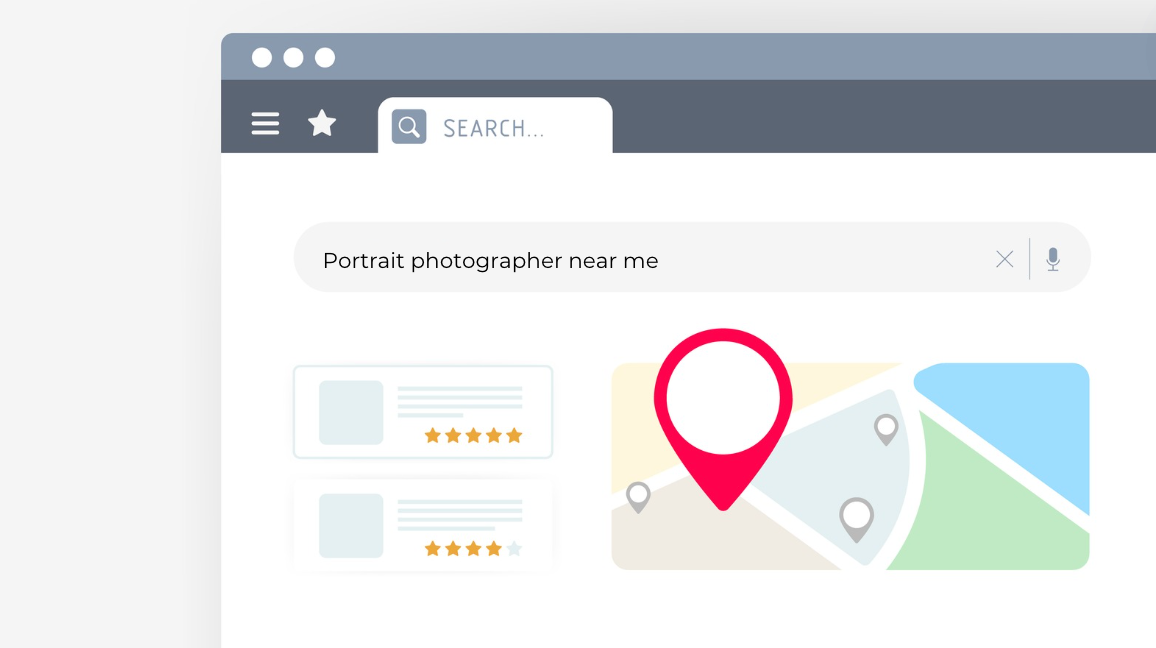
Since most clients are searching for professionals in their vicinity, local SEO (appearing prominently in local search results) is crucial. This visibility can significantly increase your chances of capturing business from those looking to hire a photographer near them.
Key Strategies to Improve Your Local SEO as a Photographer
Link building is a cornerstone of search engine optimisation (SEO). For photographers, creating a strong link profile improves their website authority and boosts search rankings but also drives relevant traffic.
Backlinks from authoritative and respected sources are seen by search engines as endorsements of your website's credibility and quality. Besides, building a portfolio of such links positions you as a professional authority in your field. Here are a few ways you can try link building:
All in all, investing time and effort into SEO link building is more than just an SEO strategy. It's a comprehensive approach to networking, marketing and business development as well.
Monitoring the impact of your SEO strategies is essential to understand what’s working and what isn’t. SEO is never a set-it-and-forget-it strategy. It requires regular monitoring and adjustment based on the data you collect.
Set aside the obvious ranking and findability perks for a moment. Consider the goldmine of insights you'll get from tracking your SEO performance. When used effectively, this data can profoundly influence your content strategy, website enhancements, and broader business decisions.
For instance, if you observe that certain types of content consistently resonate with your audience, it's a smart move to focus on producing more of that content or refining what you already have. This strategic use of data helps you optimise your offerings and aligns them more closely with audience preferences and behaviours.

If you're new to data tracking, understanding what to look at can be a bit overwhelming. Let's break down some of the key metrics in simple terms:
Well, we’ve covered quite a bit of ground together! Don't feel discouraged if the world of SEO seems scary at first, by reading this article you're already setting yourself up for success. It's all about understanding what brings visitors to your site and what keeps them engaged.
💡SEO is ever-evolving with new trends and algorithm updates, so staying informed is key to staying ahead. Most importantly, have patience with yourself and your website!
Thanks for sticking with it, and here’s to your SEO success! If you ever feel stuck, come back to these basics—they’re your reliable guideposts on this journey.